
Grupo T&C is a Peru-based luxury real estate developer with 35+ years of experience building high-end residential and mixed-use projects across South America. Edge House Miami represents their flagship North American residential expansion and signals the developer's ambition to establish a premium footprint in Miami's pre-construction market. Understanding who developed your building matters, it indicates construction quality, financial stability, and delivery probability.
What Is Grupo T&C's Background and Development Track Record?
Grupo T&C was founded in the 1980s by a Peruvian family with deep roots in construction and real estate development. The company has spent three decades building luxury residential towers, mixed-use complexes, and master-planned communities across Peru, Colombia, Mexico, and Chile. Their portfolio includes some of Latin America's most prestigious addresses: exclusive condominiums in Lima's San Isidro district, a landmark mixed-use development in Bogotá, and luxury residences across Mexico City.
The company's reputation rests on four core principles: architectural excellence, construction quality that exceeds local codes, focus on luxury finishes, and creating complete communities where residents can work, dine, exercise, and socialize without leaving the property. Grupo T&C doesn't merely build apartments; they develop lifestyle ecosystems designed around resident experience.
Edge House Miami is Grupo T&C's largest U.S. residential project to date. The developer partnered with world-class design firms (Kobi Karp Architecture, Adriana Hoyos Design, Witkin Hults + Partners) to create a flagship North American development that exceeds their prior work. This signals both ambition and commitment to establishing credibility in the Miami market.
Why Did Grupo T&C Choose Edgewater and Miami?
Grupo T&C's entry into Miami came from a calculated assessment: Miami's pre-construction market attracts international capital, Edgewater was underdeveloped relative to its waterfront potential, and luxury residential towers command premium pricing in emerging neighborhoods. The developer saw an opportunity to build a flagship tower in an area about to experience transformation.
Edgewater in 2020 was still largely industrial waterfront. Today, it's home to Midtown, emerging dining and retail, and upcoming public waterfront development (Miami Baywalk). Grupo T&C timed their Edgewater entry perfectly: early enough to acquire prime waterfront land before prices skyrocketed, yet late enough to see neighborhood momentum validate their investment thesis.
Edge House Miami also reflects Grupo T&C's commitment to the short-term rental model. Unlike many Miami developers who restrict rentals to secure "quality of life" positioning, Grupo T&C embraced short-term rental approval and created the 2-year leaseback program. This investor-centric approach signals the developer understands Miami's buy-to-rent market and wants to attract capital from active investors, not just owner-occupants.
Design Philosophy: How Grupo T&C Approaches Luxury Buildings
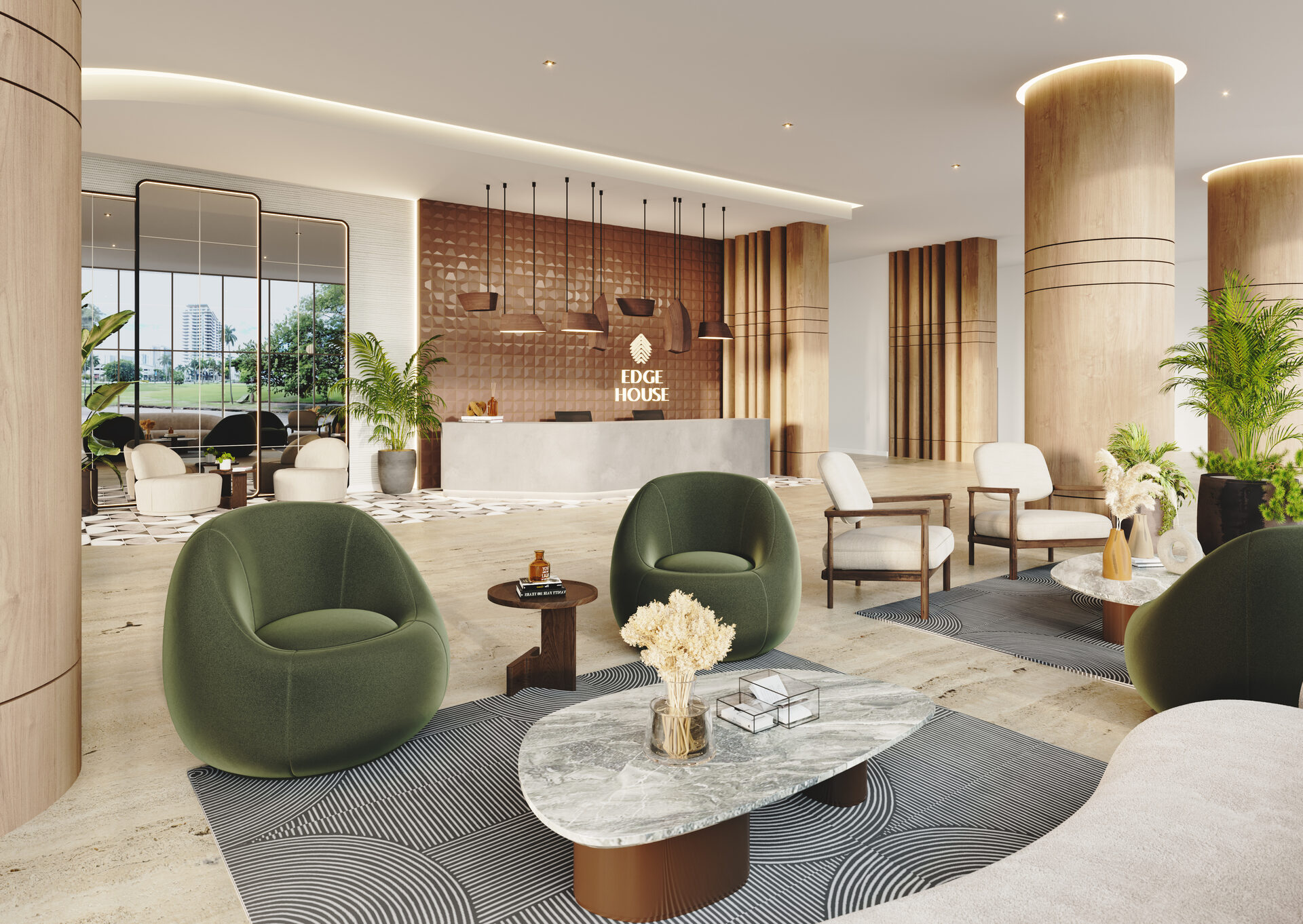
Grupo T&C's design philosophy centers on "residential completeness": the idea that a luxury tower should provide everything residents need (workout facilities, dining options, co-working spaces, socialization areas) so they rarely feel compelled to leave. Edge House reflects this philosophy: 40,000 SF of amenities, curated dining partnerships, resident lounge with library and co-working, multiple pools and recreation decks, spa and wellness facilities.
The developer's signature element is the "town square" concept: a central gathering space that functions as the building's heart. At Edge House, this is the podium level with its lobby, café, lounge, and resident-facing services. Grupo T&C believes that luxury extends beyond individual residences to shared spaces and community experience.
Another hallmark: attention to operational efficiency. Grupo T&C designs buildings that are easy to manage and maintain. This benefits both the building management and residents. Wide hallways minimize congestion, centralized mechanical systems simplify maintenance, and robust building infrastructure anticipates future needs. This operational excellence is reflected in the building's 2-year leaseback program, Grupo T&C's operational confidence allows them to offer that management program.
Construction Quality and Delivery Track Record
Grupo T&C's prior projects in Lima, Bogotá, and Mexico City were completed on or within 6 months of scheduled delivery. This is an exceptional track record in markets where construction delays are standard. The developer attributes this to conservative scheduling, robust project management, and pre-purchasing materials before price volatility affects timelines.
Construction quality metrics from prior Grupo T&C projects indicate they build to standards that exceed local code requirements. Materials specifications exceed Miami-Dade County standards. Structural systems incorporate earthquake-resistance features (relevant in Lima and Bogotá) despite not being required in Miami. This over-engineering ensures longevity.
Edge House Miami's construction timeline is 2024 to 2028. This four-year schedule is conservative relative to the building's size and complexity. Conservative scheduling is a positive indicator: it suggests Grupo T&C has built in contingency buffer, reducing delivery risk. The first major construction milestone (25th floor pour) occurred on schedule in 2025, validating their project management approach.
Financial Stability: Can Grupo T&C Deliver Edge House?
Pre-construction investment risk centers on developer solvency. Can they afford to complete construction if sales slow? Grupo T&C's financial position is strong: the company is privately held by a family with significant net worth, has completed major projects with construction costs exceeding $500M, and brings Latin American institutional investor capital to the Miami project.
Edge House Miami's pre-sales exceeded 60% before construction commenced, a critical threshold indicating market confidence and generating sufficient capital to fund construction through completion. The early success validated the project economics and secured construction financing from institutional lenders who assessed Grupo T&C's track record.
Additionally, Grupo T&C's reputation depends on delivery. A failed Miami project would damage their 35-year brand across four countries and jeopardize future U.S. expansion. The reputational incentive to complete Edge House is enormous.

The 2-Year Leaseback Program: Grupo T&C's Competitive Edge
The leaseback program reveals Grupo T&C's confidence in both building quality and operational execution. By committing to manage units for two years, the developer takes on operational work that most developers avoid. This signals the developer's confidence in rental demand; no returns are promised.
Developing the leaseback program required Grupo T&C to establish property management infrastructure in Miami: hiring experienced staff, creating policies, establishing vendor relationships. This operational investment isn't cheap, yet the developer committed to it. Why? Because they're betting that leaseback program success will drive sales, differentiate Edge House, and generate premium pricing versus comparable Miami developments.
The leaseback program also indicates Grupo T&C's long-term Miami commitment. They're not building one tower and exiting. They're establishing operational infrastructure (property management, vendor relationships, market knowledge) that positions them to develop additional Miami projects. Edge House is a beachhead, not a one-off.